“It’s chic to be drab” DS & Durga tells us in the tagline for their new fragrance, Brown Flowers. It’s an unusual statement from a fragrance brand, but DS & Durga is not your typical outfit and rather than trying to crowd please, like much of the fragrance industry, they’re not afraid to be different. The tagline and name of the fragrance come with tongue pressed firmly in cheek (Brown Flowers is so off-putting it comes full circle). But let’s not mistake DS & Durga for not being serious – they may not take themselves seriously (they have fun with what they do), but they certainly do take the creation of unique perfumes very seriously indeed.

At the London launch of Brown Flowers, DS & Durga perfumer and co-founder David Seth Moltz provided a very specific description of the inspiration of the fragrance, derived from a visit to Philip Johnson’s glasshouse in Connecticut. I shall paraphrase below:

“Perhaps someone’s aunt stays in the guest house, she’s a dilettante who gets into drawing classes, and starts making potpourri. She makes a perfume called Brown Flowers, made with a musk you can only get in Europe. Everyone’s wearing it. If she could just get a few bottles into Barneys she’ll have made it. She has a boyfriend who plays a guitar in a band, nobody knows his name. It’s a drab heavy ‘70s floral. Oh and her name is Simone by the way.”

I truly admire a brand that creates such vivid and specific olfactory stories and without a single material being mentioned in that description above, one gets a real sense of what this fragrance is trying to convey. So is Brown Flowers really a drab floral? Does it evoke the 1970s? And more importantly, should you seek it out and give it a sniff? Is it chic in a counter-culture way? Well, read on and you shall find out!

I’m a firm believer that fragrance should be approached much in the same way as fashion. You would not dream of having only one outfit for every single occasion or season, so why would you do the same with your scent? There is literally a fragrance for everything and I always try and match my scent to my outfit, whatever it is I may be doing, and the season of the time. For these reasons I’ve got into a cycle of curating a seasonal fragrance wardrobe which sits on a lovely little marble tray in my bedroom. I’ll be sharing this selection with you every season (whether you like it or not….)

Winter 2024/25 has been a very busy season life-wise and a mixed season for me from an olfactory perspective. I’ve focused on warmer scents (understandably) but have also craved freshness. I’ve leaned into the gourmand quite often (quelle surprise) and have worn a mixture of new launches and classics. There have even been one or two rediscoveries of things in my collection that I’d completely forgotten about. It’s been an exciting time fragrance-wise, so here’s a quick round-up of what I wore over the last few months.

I always wondered whether the noses and minds behind classic fragrances such as ShalimarNº5PoisonOpiumCK One etc. had any inkling that these creations would be considered as masterpieces. Did they know they were making history at the time? Or was it years later that the classic status was bestowed upon them? If so, how quickly did this happen? I think the answer varies but the moniker of classic is something that is most often awarded in hindsight and it really is the test of time that is the true decider.

We can, I think, see fragrance history in the making and it’s easy to point to a number of creations over the last decade or so that have quickly become modern classics. These are scents that have broached entirely new olfactory ground and have become hugely popular because they smell so entirely unique. I’m talking about fragrances such as Maison Francis Kurkdjian’s fiery marine Baccarat Rouge 540, Le Labo’s crystalline woody Santal 33, and of course, Marc Antoine Barrois’ spacially ethereal Ganymede.

Ganymede comes from a creative partnership between couturier Marc-Antoine Barrois and perfumer Quentin Bisch. They speak of their kinship as part of this creative synergy and how it has helped translate Marc-Antoine’s emotions and imaginations into olfactory art. Ganymede is described as a fantasy, one inspired by the moon of Jupiter and the Trojan prince from which the satellite takes its name. That all may sound a little bit abstract, but Ganymede is an abstract, cerebral fragrance that presents an entirely new olfactory experience. Is it destined to be a classic? Well, I think the answer to that is incredibly simple: it already is.

In this review I’m sniffing Ganymede in both its Eau de Parfum and Extrait concentrations. Two perfumes born from the same creative spark but with completely different points of view.

Let’s Sniff!

I do not think that for one single day in my 37 years of life I have been cool (0/13,745 is an impressively poor hit rate, let’s be real). I do not say this to fish for compliments or to garner sympathy, I say it as a stone cold fact: I am not cool. Cool people set trends and operate without really caring about what others think about them. I am not that kind of person. I barely follow trends, let alone set them, and I care far too much about what people think about me. So no, I’m not cool, but occasionally fragrance allows me to pretend that I am.

This is why I love fragrance so much. It’s smelly cosplay. I can spray on a scent and it will give a specific impression and convey to the world something I want to be and sometimes that thing I want to be is cool. I say all this because I think I have found a brand that has a collection of fragrances that feel like sprayable cool and that brand is D.S. & Durga.

Founded by husband and wife duo David and Kavi, D.S. & Durga’s mantra is “perfume is armchair travel” and I think that really resonates. Fragrance transports us, not just to places, but also to moments in time, emotions and feelings. Unlike me, D.S. & Durga doesn’t have to try to be cool, it just is. It has a simple visual aesthetic, with bold typeface, a quirky sense of humour that is attractive and, most importantly, fragrances that live up to the hype.

So, if you are in the market for a little bit of Eau de Cool or you’re just wanting a bit of an intro to the brand, I thought I’d share five scents from the collection that feel like highlights.

When I think of brands that have mastered the very concept of “aesthetic” I immediately think of Aesop. Presented as a sort of modern apothecary, the Australian skin, hair, and body care brand has managed to strike that balance of style and substance with effective, high quality products that look good. Yes, OK, people would maybe judge you for having an Aesop hand soap in your bathroom these days because they’d perceive you as wanting to look cool, but also those people are dumb, snobby, and stupid and we should not listen to them. Aesop hand soap is lovely, that’s all that matters.

Aesop now has a decently-sized fragrance collection under its belt (11 at current count). I recently paid a visit to their Marylebone store to explore their olfactory offering and was impressed by the quality of their selection. Whilst their simple, amber-hued apothecary bottles may look unassuming, each scent has a clear story, told through interesting materials and unique olfactory twists. (Slight exception for Hwyl which, whilst being a beautiful incense, has a cluttered story of Japanese forests and Welsh names, but we can overlook that) I enjoyed them all in one way or another but it was Ouranon which stood out. 

Ouranon is described by Aesop as a celebration of endings and new beginnings. Perfumer Barnabé Fillion used Jordan as a reference point and the result is a composition that unfurls slowly, revealing unexpected fragrant surprises at each turn. Whilst all of the fragrances in the Aesop collection are worth smelling, Ouranon stands out as the most beguiling, unique, and divisive. To me, that’s a scent worth exploring!

Let’s Sniff!

There’s something to be said about beauty in simplicity and the latest launch from eco- and ethically-conscious fragrance brand Sana Jardin is a perfect example. It arrived on my doorstep after a long day working, followed by a long commute home. I spritzed some on after I’d got in, changed (sweats and slippers, if you must know), and had dinner. One sniff and I felt my whole body relax: there was nothing fussy, gimmicky or overly complicated, just a really beautiful scent to enjoy.

Air of Aquarius was inspired by cosmic alignment, specifically the “celestial symphony of Pluto’s return to Aquarius in January 2024” and the composition centres on the essence of lemon, which is described by the brand as being “a flower renowned for its spiritually cleansing properties and ability to enhance mental focus.” It’s a clean, crisp, citrus-soaked floral that certainly brings a sense of calm which, after a long day of doing whatever it is I do for a living (most days I’m unsure), is much needed.

Let’s sniff!

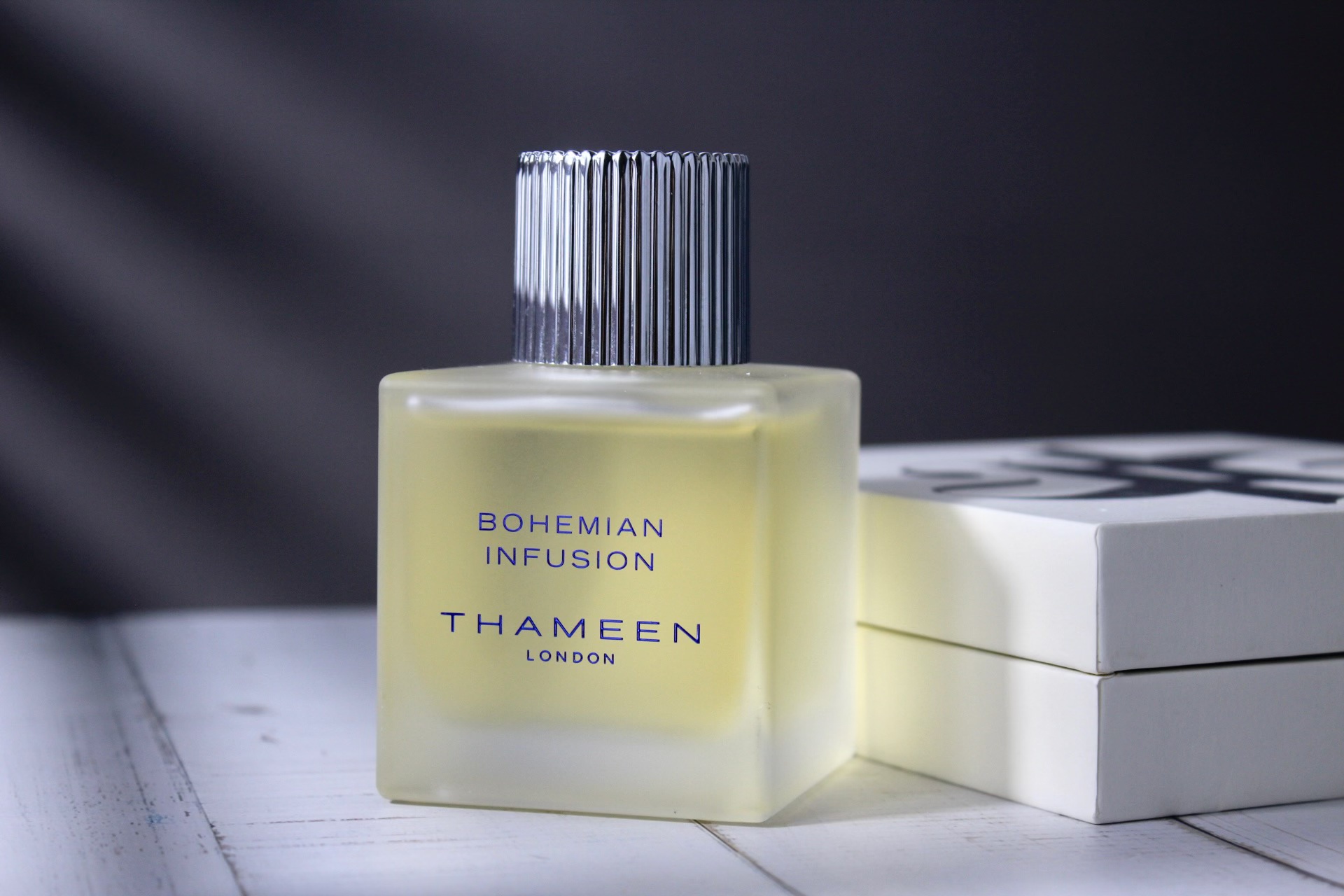
Christopher Chong, in-house Creative Director at Thameen London and I have something in common: we’ve both taken an extended break from the world of perfume but now we’re back! I’m certainly very happy to be back and to be smelling his work again. You’ll be familiar with Christopher’s fantastic work at Amouage, a brand that he really turned around and brought to the forefront of niche perfumery. The perfumes he creates are bold, innovative and often times challenging. He is not one to shy away from brashness, working with world-class perfumers to push the boundaries forward. You may have not loved everything he did at Amouage but you can never accuse anything he has worked on of being boring and for that, he deserves a huge amount of respect.

Having taken up residence at Thameen London, Chong presents The Britologne Collection. Consisting of six fragrances (as of now), this capsule collection within Thameen London’s wider oeuvre is an homage to Britain and the traditional Eau de Cologne, fusing both words together to create Britologne. The result is a collection that subverts that classic Eau de Cologne structure, pushing it firmly into the 21st century with fragrances that are dramatically unique and fantastic examples of olfactory storytelling. The Britologne Collection may be inspired by familiar themes, but if I’ve learned one thing from my years of sniffing perfumes created under the direction of Christopher Chong, it’s to expect the unexpected.

Let’s Sniff!


A few weeks ago I was lucky enough to attend a virtual masterclass with Frederic Malle and perfumer Anne Flipo all about the brand’s latest launch Synthetic Jungle. I was intrigued by the fragrance, of course (we will get on to that soon – patience please) but I was also curious about the name. Given all of the scaremongering around materials in perfumery – you know what I mean, the false narratives around chemicals being bad (literally everything is a chemical, oy), that natural is better (simply not true) and that clean beauty is a thing (I don’t even know where to start with this one) it seems somewhat brave to release a fragrance with “synthetic” in the name. I asked M. Malle whether the name was a statement and he, without hesitation said yes, it is.

In response, he told me that there is a misconception that synthetic materials are bad and naturals are good, adding that people don’t understand that interesting perfume started because of synthetics (it’s true, we wouldn’t have modern perfumery as it is today without aroma chemicals). As he explains, Synthetic Jungle’s name seeks to remind people that perfume is a paradox, and that synthetic materials are required to recreate the smells of nature. This is exactly what Synthetic Jungle achieves – a beautifully natural smelling perfume, evocative of a lush jungle, and made with a mixture of both natural and synthetic materials.

Now, moving past the name, what about Synthetic Jungle the perfume? This is the result of a long creative flirtation between Frederic Malle and Anne Flipo, where the former spent quite some in the corridors of IFF convincing the latter to work with him. The starting point for their fragrant collaboration was the green fragrances of the 1970s, specifically Estée Lauder’s Private Collection, which served as inspiration. Synthetic Jungle is Frederic Malle and Anne Flipo’s rendition of the green chypre accord – a simplified, modernised version that isolates the green accord and amplifies it with intense floralcy. The result? An accessible take on green that feels operatic in its execution.

Let’s sniff!


We’re just over a week into 2021 and we already have the first big perfume launch of the year, which means this is my first perfume review of the year (exciting!) and it’s for a brand new CHANEL fragrance (very exciting!!) – a CHANEL Exclusif, no less (ARGH SO EXCITING!!!). This CHANEL fanboy is very please to be kicking off the year with something so wonderful – so, let’s take a few moments away from the world and enjoy a spot of scented beauty.

The latest addition to Les Exclusifs is Le Lion and it’s a long-awaited one, having launched in some territories almost one year ago! But now it’s here! As with all of the Exclusifs, Le Lion takes inspiration from the house itself, and this time the lion, the fifth sign of the zodiac and Gabrielle ‘Coco’ Chanel’s astrological sign, is the theme. In the 1920s, Coco fell in love with the city of Venice, being inspired by its art and culture, and like Chanel herself, the city existed under the guardian sign of the lion. The lion became an emblem for Chanel, both in her personal spaces (her apartment at 31 Rue Cambon was filled with lions crafted from marble, bronze and wood), but also in her clothing, with the symbol engraved on the buttons of tweed suits or the clasps of bags. The lion is a symbol of Chanel’s tenacity and endurance and this is the theme that the fragrance explores.

Le Lion the perfume, seeks to capture this tenacious personality but also the rich and exotic spirit of Venice, the city of the lion that Coco loved. CHANEL perfumer Olivier Polge was intrigued by the emblem of the lion rather than the animal itself, crafting a warm amber fragrance (I’m not using the “O” word, this is my replacement) with a “solar aura” and a “gentle strength”. Le Lion stands out as a uniquely intense and warm fragrance within Les Exclusifs, which tend to lean light, ethereal, abstract, and it is quite surprising in its richness. The big question though, is whether it was worth the wait? Well, read on and you shall see!


Comme des Garçons is a brand that gets a pretty regular rotation in my wardrobe. In fact, I’d go as far saying that it would would quite be odd for a week to go by without me picking out one of their scents to wear. For me, they strike that perfect balance between novel and innovative, and pleasant and wearable, which means that I reach for them quite a lot, mostly for those in the regular lineup such as the original Parfum, 2, 2 Man (I just topped up on my bottles of both the 2s, in fact), Amazingreen and Blackpepper. Long story short, I enjoy the brand and the scents are staples for me.

With that in mind, a new Comme des Garçons fragrance is somewhat of an event for me – I’m always intrigued to see what they do and whilst not all are ones I adore (see Floriental, Copper and Concrete), I do always enjoy how they subvert expectations. A Comme des Garçons fragrance always has something to say and their latest launch, Rouge (currently exclusive to Dover Street Market and launching nationwide next year), is no exception. Described, in typical CdG style as an “encounter between religious fervour and earthen reality” Rouge attacks the the colour red from surprising angles, using a central note of beetroot to present something so familiar in an entirely unfamiliar way. To say it’s interesting and unique is somewhat of an understatement…

Through deliberate overdose and rapturous expression, Rouge presents an unexpected unison. an olfactive congregation of desire archetypal associations of the colour Rouge seen and subverted through the distinctly disruptive gaze of Comme des Garçons.

Comme des Garçons