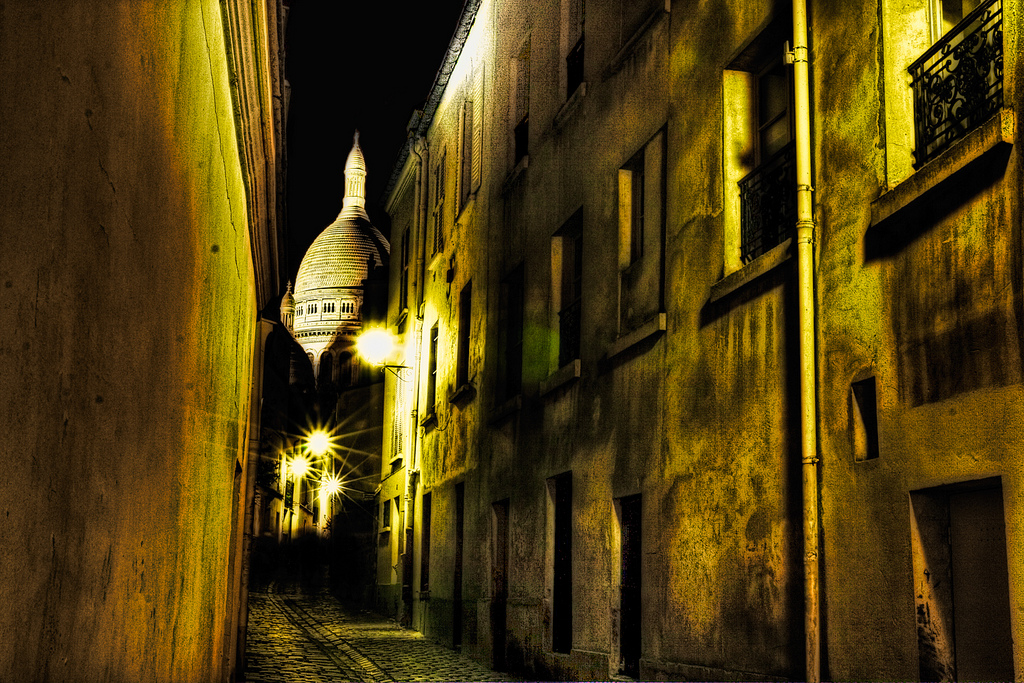
Streets of Paris

“Nuit de Tubéreuse – Evocative of stifling, humid Parisian nights.”

In perfume nothing is certain, tastes change and develop, and those fragrances we once loved can quickly fall out of fashion and become yesterday’s news. Just as we can lose love for fragrance we once admired we can also find love for those that we’ve hated, ignored or felt unimpressed by. I like to call this big perfume turn around ‘The Big 180’ as in the big ‘180 degrees turn around’.

I’m sure many of you have experienced the big 180 before, we’ve all had that moment where you pick up a sample or tester of a fragrance that you have smelled a million times before, knowing full well that the juice inside has failed to impress, or even disturbed you in the past. But this time something between you and the fragrance just clicks. Suddenly you understand the fragrance in a way you never did before, stars aligns within the universe and a new found appreciation is formed.

I had a big 180 recently with a perfume I genuinely disliked, namely Nuit de Tubéreuse by L’Artisan Parfumeur. I’m a HUGE fan of tuberose (see The Candy Perfume Boy’s Guide to Tuberose) and everything about L’Artisan’s most recent tuberose offering offended my nose; I found it to be sour, almost sticky in texture and unpleasant. It just so happened that another L’Artisan fragrance, the upcoming Séville à l’aube that led me to revisit this maligned tuberose and that’s when the big 180 happened.


Sun Through the Trees

Oud is a note that seems to have had a great deal of popularity over the last few years. Most perfume houses have an ‘oud’ in their line-up, in fact many have several – anybody who’s anyone has got one. Despite it’s prolific presence in today’s perfume landscape, it cannot be denied that oud is a wonderfully powerful material, that when used properly can be one of the most beautiful smells known to man.

Oud is the jigsaw piece that helps fuse European and Eastern styles of perfumery together, and whilst the oud that is used in western perfumery is much cleaner (and largely synthetic) than that used in the east, it has coloured the face of perfumery in bright arabian hues and taken us on exotic voyages to faraway lands.

Oud

Oud/Oudh/Aoud/Agarwood is a “dark, resinous heartwood” [1] that forms in infected Aquilaria trees. The infection is due to a specific type of mould, that changes the colour and density of the wood, leaving a strong, dark resin (the oud) in the core.

Due to its rarity and variation in quality and scent profile, oud is a very difficult and expensive ingredient to work with, hence why the majority of oud fragrances use a synthetic substitute.

Mad Scientist

The Mad Perfume Scientist

‘Layering’ – the practice of layering two fragrance compositions to create weird and wonderful combinations, has always seemed completely alien to me. I have always enjoyed the fragrances in my collection exactly the way they were created (I wouldn’t have bought them otherwise) and have never felt the need to try and improve or change them by adding something new.

Despite my skepticism, layering seems to be something that a lot of perfume-lovers do and enjoy. Some brands, such as Jo Malone, even actively encourage the practice of layering with their fragrances. These ‘layering’ combinations are designed to enhance the perfume experience, but I can’t help but feel that they are just a cheap ploy with the sole intent of convincing consumers to buy extra bottles.

Despite my skepticism, this layering malarky got me thinking (a dangerous habit, I know); is there any real merit to mixing perfumes? and; Can you actually enhance a perfume by layering it with another? So, in the interest of science I thought that I would conduct a few layering experiments to see whether there is any merit to it, or whether it’s just a bunch of phooey.

Rio Carnival

“Refreshing as a cocktail, sexy as a Brazilian dance.” [1]

I was quite late to the L’Artisan Parfumeur party. I remember trying three of their most popular scents (Tea For Two, Patchouli Patch and Voleur de Roses) way back when I first started getting into the world of perfume. I didn’t enjoy them at all and the line wasn’t too easy to find in the UK, so in my ignorance I ignored the line for quite a while. What a mistake that was.

Since the opening of their Covent Garden store I have had the opportunity to revisit the L’Artisan Parfumeur line and this time with much more encouraging results. I now own and love two (Traversée du Bosphore and Vanille Absolument) and I could quite happily add a few more (Al Oudh, Dzing! and L’Eau d’Ambree Extreme) to my collection. Now that I have made friends with the line, a new release is always exciting news and I very much looked forward to trying Batucada.

Batucada is the latest addition to L’Artisan Parfumeur’s ‘Les Voyages Exotiques’ line and “is a celebration of contemporary Brazil in a vibrant, joyful and sensual perfume, inspired by the effervescence and rhythm of Rio – Batucada is the name of a percussive style of samba music” [2]. Created by two perfumers; Karine Vinchon in Grasse and Elisabeth Maier in São Paolo, Batacuda is designed to be a vivacious, sparkling cocktail evocative of the spirit of the streets of Latin America.

Les Voyages Exotiques

Les Voyages Exotiques

I chose to review Traversée du Bosphore and Vanille Absolument together because they have something particular in common. In fact, they have lots in common; they are both from L’Artisan Parfumeur, are both part of the ‘Les Voyages Exotiques’ line, were both composed by genius perfumer Bertrand Duchaufour and are both gourmands, but that’s not why I have lumped them together in this review. No, it turns out that the particular thing they have in common is the fact that I’ve been searching for them for a long time.

I believe that my collection of fragrances is like a wardrobe, and just like a wardrobe there are different ‘pieces’ for different occasions. Within your fragrance wardrobe you will have fragrances for work, for going out to dinner, for partying, for summer and for winter. You will also have necessities that no wardrobe is complete without, so with clothing it might be the little black dress or the black t-shirt, and with fragrance it would be the vanilla fragrance or the happy-go-lucky citrus. Us perfume enthusiasts are on a continuous journey to complete our wardrobes and we revel in the joy of finding perfumes that plug any gaps.

Both of these ‘exotic voyages’ have taken me on a journey filled with wonderful discoveries and fragrant epiphanies. I have discovered two perfumes that have each found a prominent place within my collection. In Traversée du Bosphore I found the Turkish Delight fragrance I had been looking for, and in Vanille Absolument I have discovered the vanilla to fill the missing spot within my collection.