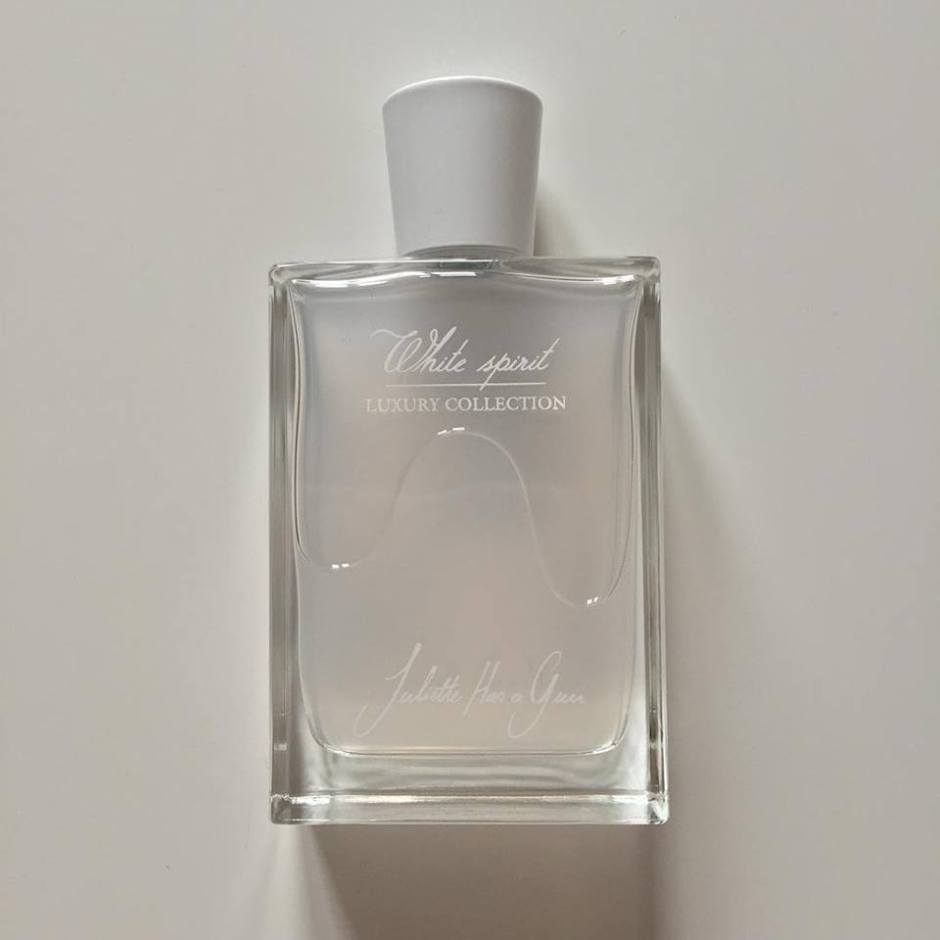
Addiction. That’s the inspiration between Juliette Has a Gun’s latest fragrance ‘White Spirit‘. The fragrance is dangerous, Romano Ricci (the man behind Juliette) says, further stating that a failure to respect the prescribed dosage may lead to the wearer never being able to do without it. That dose, by the way is “one or two drops delicately placed in the hollow of your neck”. Well, I threw caution to the wind and took five sprays to the chest on my first wearing, and I have survived to tell the tale. Although, that said, I have worn it a number of times since, so maybe I haven’t quite escaped the White Spirit’s dark passenger entirely.
What about the scent though? What’s it all about? Well, White Spirit is a melange of flowers and in true Juliette Has a Gun style, an array of aroma chemicals. Romano Ricci describes it as “a contrast between minimalism and poison […] the virginal white flower versus the explosive woody dry accord” defining it as “an unlikely cocktail, yet resolutely addictive”. The presentation is one of the brand’s finest examples, showcasing a white capped bottle filled with a milky juice that appears as a substance to be applied with caution. As always, it’s all served with a sense of irony and tongue pressed firmly in cheek, after all, that’s the ‘Juliette’ way.
Under the direction of Christopher Chong, Amouage has positioned itself as a renegade perfumery that creates daring yet luxurious perfumes. Where many perfume houses at the top end of the scale are content putting any old juice in a fancy bottle, or just a juice that is likely to please many, Amouage seek to drive the face of perfumery forward, always developing fascinating, novel and unique fragrances. Of course, not everything they do is going to appeal to everybody, but that’s exactly the point and being divisive is always a key element in being truly great. So with Amouage it’s not guaranteed that one is going to fall in love with a fragrance however, what can be relied upon is that whatever they create will never, ever be boring.
The Library Collection is where Christopher Chong really stretches his legs. The collection now consists of ten fragrance, with this tenth edition, ‘Opus X‘, entering the fray as yet again, something entirely different. So far we’ve fallen asleep in a wistful dream of mimosa and violet in Opus III, reimagined our memory of amber in Opus VI, donned a cracked leather jacket of emerald green in Opus VII and inhaled huge waves of jasmine silk in Opus VIII. To say the journey of the Library Collection has been incredible is an understatement and with this tenth instalment in the series, one is treated to something incredibly special.
Opus X was created by Pierre Negrin, a familiar nose for Amouage’s most recent creations and Annick Menardo, the legend behind Dior’s Hypnotic Poison, Lolita Lempicka and YSL’s Body Kouros, to name just a few. I’m just going to say it: this is a dream team of perfumers and it shows in the results. Opus X is an intelligent take on rose that is not afraid to be evocative of unconventional things, specifically; blood, varnish and metal. It’s a rose like no other, one that is awe-inspiring in both its size and its uniqueness. As Persolaise says in his review, Opus X is ‘striking’.
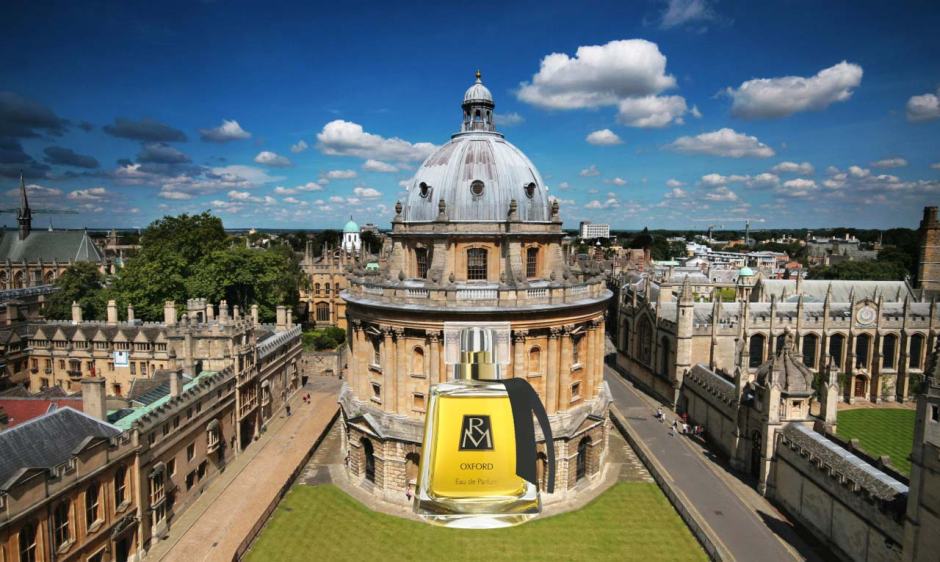
I feel like we’re going from the ridiculous to the sublime with fragrance reviews on The Candy Perfume Boy this week. We started with Frédéric Malle’s Monsieur., which whilst fabulously composed is almost comically butch (which in my world is a compliment, of course) and yet we finish with Ruth Mastenbroek’s Oxford which is an entirely more refined and subtle affair. The two fragrances are so different in fact, that a comparison would be silly, so let’s move on and focus solely on Oxford.
Oxford is Ruth Mastenbroek’s third fragrance and it’s a unisex scent inspired by the perfumer’s time spent studying at Oxford University. It’s classified as an oriental, but as one would expect from a fragrance inspired by an established British institution, this is far from an East-looking perfume, in fact it takes the familiar notes of this fragrance family and spins them into something hopeful and free-spirited, just like one’s university days. The official description of Oxford is as follows:
“…inspired by my experiences at Oxford University, where I studied chemistry at Lady Margaret Hall. The scent of the French cigarette brand Gitanes, with its connotations of other-worldly chic and sophistication, was new to me as an innocent undergraduate. It came to embody for me the moment of discovery- when you realise you can make your own mistakes, your own choices, and discover life’s extraordinary adventure. I describe Oxford as the scent of an awakening.”
Retro Machismo – Monsieur. by Editions de Parfums Frédéric Malle
“Monsieur., your chest rug is peeking through your shirt.”
“Monsieur., would you like the bear skin rug dry cleaned before you lie seductively upon it?”
“Monsieur., the 1970s called and they would like their headshop back.”
“Monsieur., is that an afro comb in the pocket of your flares or are you just pleased to see me?”
These were my initial thoughts when smelling ‘Monsieur.‘ the latest release from Editions de Parfums Frédéric Malle. As you may be able to tell, it’s somewhat of a retro macho bomb and style wise, it certainly comes across as somewhat of a departure from Malle’s ultra-modern aesthetic. That said, I find it to be fabulously retro, which is to say that it celebrates a moment in time and a certain type of machismo that is utterly classic: that of the hairy chested, suave yet roguish animal of a man, or in this case a slightly older man. Wait, is Monsieur. a DILF?!
Monsieur is the second outing at Editions de Parfums Frédéric Malle for perfumer Bruno Jovanovic, the man behind the delightfully subversive Dries Van Noten par Frederic Malle and designer scents such as Calvin Klein Reveal. With Monsieur., Jovanovic tackles patchouli, a staple ingredient within the world of perfumery that has made many a fragrance a classic. The thing with patchouli though, is the fact that it feels a bit old fashioned. It’s still used in perfumery today, of course, but most examples of the note today show it as sanitised to nothing but a dark fuzz that adds texture to the composition. Gone is that dirty, earthy and oily melange that we knew as patchouli in the 1970s and 1980s. Monsieur. however, aims to pay homage to the multi-faceted and complex nature of this ingredient and the perfumes of yesteryear, with over 50% of its composition comprising of patchouli sourced through molecular distillation. As the brand puts it; “Monsieur. is to patchouli what Carnal Flower is to tuberose”.
So Monsieur. is a patchouli weapon – a tool for seduction for the man suave enough to wield its powers responsibly. As Persolaise noted in his review, it’s also a fragrance that looks backwards rather than forwards, making it an interesting step in the Editions de Parfums oeuvre. Although evocative, I’m sure my description of Monsieur. as a somewhat-attractive paternal figure may not be what the brand intended, I shall therefore, refer you to the official description as per Editions de Parfums Frédéric Malle:
“Although seemingly simple, this formula evokes for Frédéric Malle, since its genesis, remorseless seducers such as Alfonso de Portago, Mark Birley, Jose-Luis de Villalonga or Gianni Agnelli. Their manly and timeless elegance has relentlessly guided the development of this empowering perfume. Monsieur., a neo-classical perfume, manly and utterly elegant. Monsieur.”
Each year, Jo Malone London presents us with a limited edition collection of five or so scents on a particular theme. In the past we’ve been treated to afternoon tea with beautiful delicacies such as Grapefruit & Assam and Sweet Milk, not to mention the gorgeous London Rain collection which included the amorphous Rain & Angelica, which is one of their most unique fragrances to date. It’s always exciting to see what the brand will do next and where the eccentrically British streak will take them. This time their quirky sensibility sees them walking children in nature, specifically in their very own herb garden.
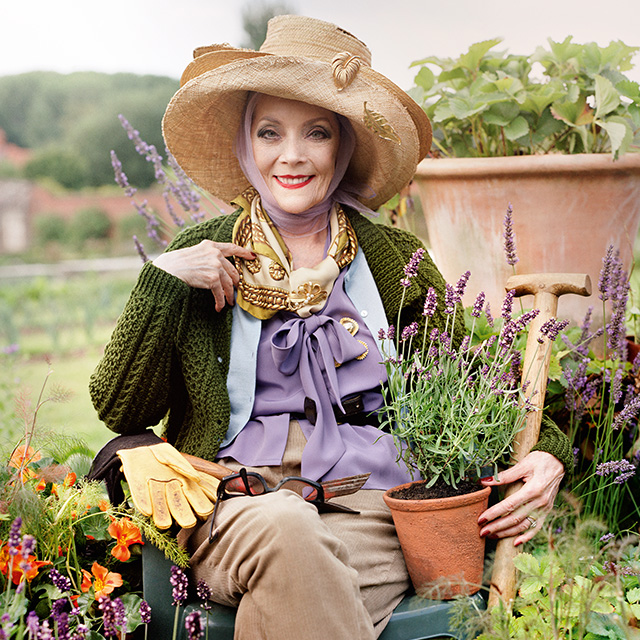
The Herb Garden collection consists of five fragrances, each of which pairs two notes found within your typical British garden, all served in the traditionally eccentric style of the house. Each scent was created by the perfumer Anne Flipo (L’Artisan Perfumer’s La Chasse Aux Papillons and Chloé Love Story) in her first collaboration with Jo Malone London. Each fragrance is billed as presenting freshness with a distinct personality, evoking the wildness of the herb garden. On a side note, completely irrelevant to the scents, can we just give a big bravo and round of applause to Jo Malone London for utilising the ever so fabulous older model in the campaign image above? More of this please, perfume industry! Anyway, back to the scents themselves…
“A day in the herb garden. A quirky tapestry of fragrant foliage, entwined with flowers and fruit. Satisfying stems of fresh English lavender. Overflowing pots of spicy nasturtium and leafy clover. Lemon thyme crushed in soil-covered hands. And cool earth encasing ripening carrots and fennel. The aromatic artistry of herbs; verdant, crisp, juicy and sweet. A captivating and delectable collection.”
“Think of a famous French perfume from the previous century and it will undoubtedly a chypre”
– Heeley
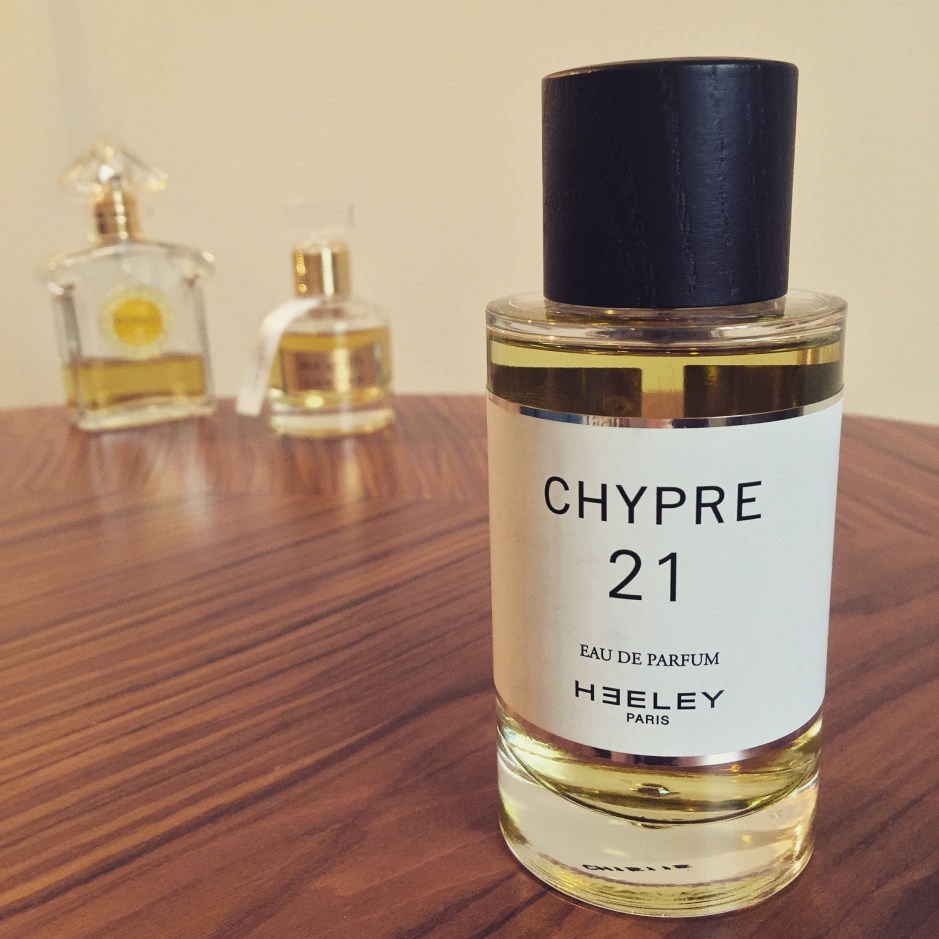
No perfume genre has had a harder time assimilating into the 21st century than the chypre. Often seen as the steely-eyed, stoic bastions of complex perfume personalities, the chypres of the world, take time to love. Established in 1917 by François Coty, the chypre genre has long been associated with the classics of French perfumery but can now seem dated, harsh and too complicated to understand. Personally I love a chypre. I adore their often standoffish nature and on the flip side, their sometimes cuddly, fuzzy hearts.
The problem with chypres is not that they are old fashioned, far from it in fact, the classic chypres are positively wonderful, no, the problem is that perfume houses don’t want to make them any more and when they do, we end up with something that is too sanitised, too pretty and ultimately not a chypre. The 20th century was the domain of Guerlain’s Mitsouko and Carven’s Ma Griffe whereas in the 21st century we have Idylle…
For his latest launch, Chypre 21, perfumer James Heeley intends to drag the chypre into the 21st century whilst paying homage to the classics of the genre. He wanted to create “an ode to Parisian chic” in the form of a “contemporary unisex fragrance” that takes all of the requisite building blocks of a chypre – bergamot, rose, patchouli, oak moss and sandalwood – but modernises them into something altogether more befitting of today. The result is both nostalgic and forward thinking.
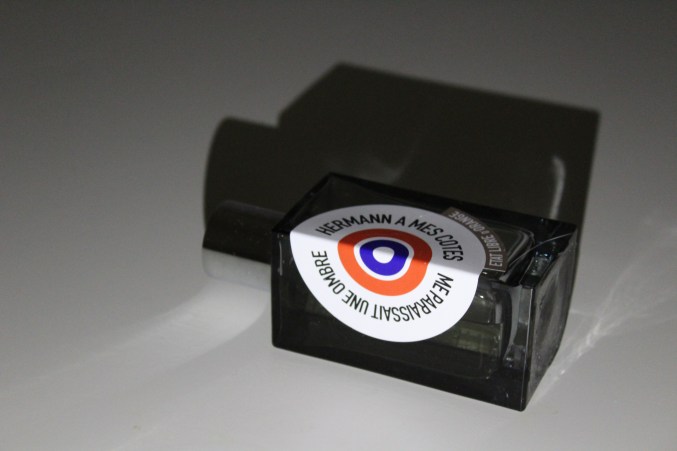
“By my side, Hermann seemed to me like a shadow” – that’s the name of the latest fragrance from rebellious niche brand, Etat Libre d’Orange. A long, pretentious name in French is no real surprise from a brand that shot to fame by marketing a fragrance using the icon of a spewing dick, but much like all things Etat Libre d’Orange, this particular scent, with its particularly long name is absolutely fascinating, albeit without any erotic influences. Not that sexual innuendo, naughty hijinks and a healthy sense of humour are bad things, mind you!
Etat Libre d’Orange have moved into a new phase. Gone are the hilarious, shocking and hyper-sexualised names, and cartoons, all in favour of concepts inspired by Nijinsky’s ballets and poems by Victor Hugo. They seem to be treading a more serious path and elevating their olfactory art to a higher level. I think it’s a good move, one that will prevent them from being pigeonholed as the antisocial abuser of good taste. That rebellious and crass streak still exists – the spirit is very much alive in the brand’s back catalogue, but for now, Etat Libre d’Orange want to stand out for being innovative, not for being innovative and rude. I say power to them.
Hermann à Mes Côtés Me Paraissait Une Ombre, or ‘Hermann‘ for short, is inspired by Victor Hugo’s poem ‘What Two Horseman Were Thinking in the Forest’ and was created by Givaudan perfumer Quentin Bisch (La Fin du Monde & Ambre Imperial). The perfume plays with the idea of shadows, with shade serving as our companion or even our fragrance. They call it your alternate self – that side of you that is always there, whether it can be seen or not. Perfume too, can be a second self – a character we wear to send a message about who we are and who we want to be. But what happens when that second skin talks back? Etat Libre d’Orange seems to want to find out.
I’m just going to come right out and say it: I’m rather fond of Jo Malone London. There is nothing more fun to me than untying the handsome black ribbon off the top of those beautiful yellow-cream boxes and pulling apart waves of tissue paper to reveal a gorgeously-scented treat for me or my home. There’s joy in those boxes, whether it be a bottle of Cologne or Cologne Intense, a scented candle or a bath oil, or all of the above (if the box is big enough, of course). They do what they do very well and their fragrances, which are odes to perfumery’s most famous and beautiful ingredients, present traditional themes with an eccentrically British twist. They’re often fun, sometimes striking and always eminently wearable. That’s Jo Malone London.
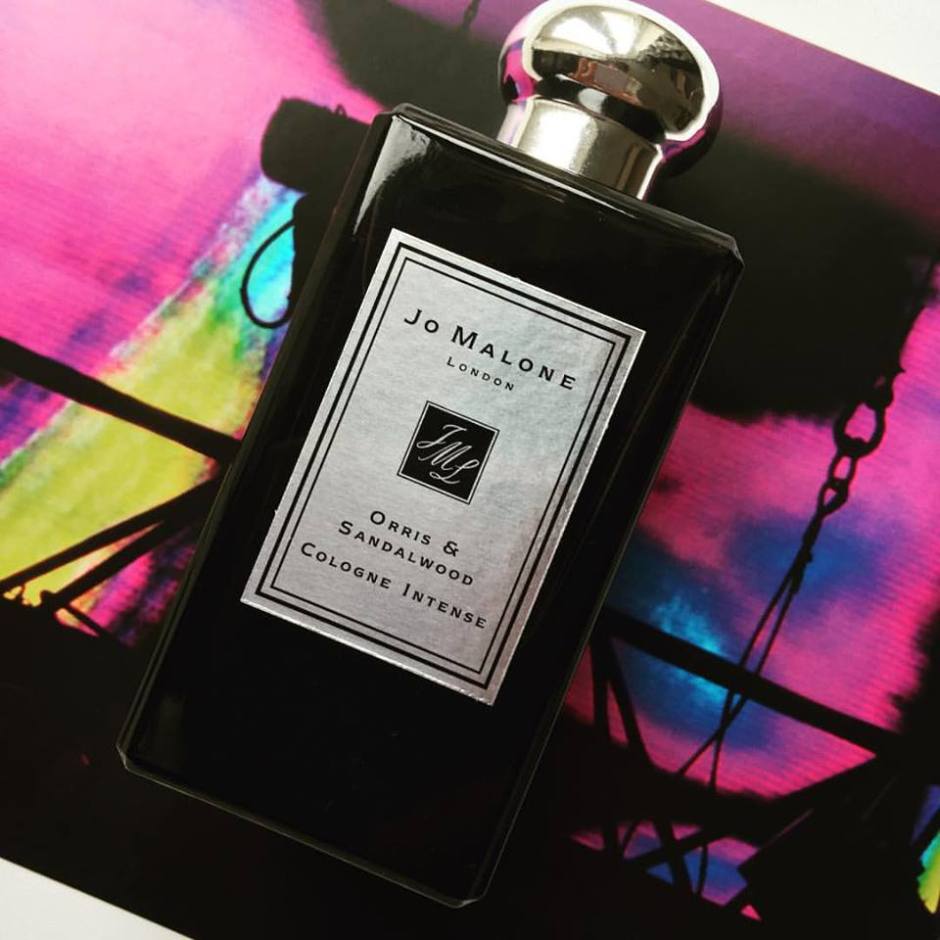
In their Cologne Intense Collection, the brand steps away from their lighter and more ephemeral sensibilities to explore richer notes in higher concentrations. These are often more opulent and exotic fragrances that have a bit more heft to them (but not too much, mind you). This is the collection where you will find ingredients such as oud, tuberose, incense and rose, all in their full, fragrant glory, and presented in Jo Malone London’s unfussy and relatable style. In January, the brand added the next chapter to the Cologne Intense Collection and two more ingredients to their ever-expanding list of notes explored: Orris & Sandalwood.
“This scent was about framing the orris to bring out its unique duality; it is both woody and powdery, floral and deep. We did this by using other woods as well as waiting a picture of the iris flower itself.”
– Pierre Negrin
Orris & Sandalwood, the latest instalment in Jo Malone London’s exploration of intensity was created by Pierre Negrin, the perfumer behind such masterpieces as Amouage’s Interlude Man and Tom Ford’s Black Orchid Voile de Fleur. Working with one of his favourite materials within the perfumer’s palette, Negrin states that he loves the complexity of orris, describing the note as a “perfume in itself” due to its varied odour profile which is “warm, sensual, feminine, masculine, violety, woody, powdery”. It’s no surprise then, that Negrin was excited to “create something new with such a classic ingredient”, and that is exactly what he managed to do. Orris & Sandalwood is billed as the next journey within the Cologne Intense Collection, one set in Tuscany during the iris harvest. It’s an exploration of perfumery’s most beautiful and expensive ingredient, all served in the contemporary manner that Jo Malone London is famous for, all with a touch of Pierre Negrin’s signature flair. It’s sounding good already, isn’t it?
Happy new year to you, Dear Reader. I hope that you had a wonderful Christmas involving lots of fragrant gifts and that your new year was a ball. 2016 will be The Candy Perfume Boy’s fifth year and it feels like the blog has come a long way since our very first post (a review of the ill-fated but remarkably beautiful Shalimar Parfum Initial, no less) back in July of 2011. Last year was a stressful year for me personally, due to work, the loss of a friend and an exciting, yet complicated house move, and it would be fair to say that my posts have not been as regular as they should have. I hope to change this for 2016 with more regular reviews and instalments in series such as The Scent a Celebrity Series and The Candy Perfume Boy’s Guide to. Here goes!
One thing I’d like to do is look back a bit more. The perfume industry is so active, with thousands of launches each and every year, and it’s very easy to get caught up in all that’s new and exciting. So when there is time and the mood strikes, I’d like to focus on fragrances that aren’t brand new, but are wonderful none the less. Kicking us off on that theme are two recent discoveries for me from the legendary niche house L’Artisan Parfumeur. These two scents, Tea for Two and Bois Farine, show how meticulous and measured the brand was during its more focused days. L’Artisan seem to have been seeking an identity for themselves over the last few years and have created some exquisite scents along the way (Séville à l’aube, Traversée du Bosphore, Déliria, Al Oudh, Nuit de Tuberéuse etc.), but the greatness of the some of the oldies in the collection cannot be ignored. Tea for Two and Bois Farine are two standouts.
It honestly does not take much convincing to get me on board with a fragrance called ‘The Orchid Man’. I am, after all, a well-documented lover of all things floral and I always feel encouraged by a modern launch that gears a floral towards men. As a man, or a boy (The Candy Perfume Man just sounds a bit creepy, doesn’t it?), whichever fits, I get tired of the industry’s attempts to encourage me to wear brutish things with burly ingredients, solid things like cedarwood, amber and oud. I like all of these things, but sometimes a guy wants to sissy things up with a great big whack of indolic jasmine, do you feel me? I am confident enough in my sexuality to not care about labels so a masculine floral, or a floral of any kind for that matter, is a no-brainer.
So yes, I was very intrigued when a bottle of Frapin’s latest fragrance, ‘The Orchid Man’, arrived on my doorstep, partly due to the fact that I’ve never really tried anything from the brand before. Without giving too much away, I must say that after spending some time with The Orchid Man, I certainly feel motivated to spend more the with the brand. Inspired by the life and fashions of French boxer, Georges Carpentier, The Orchid Man takes its name from his nickname, which is a reference to the orchid corsage he often wore with his suits. As a man of many talents, Carpentier was than just a boxer, he also was a star of stage and in film, a dabbler with the sport of Rugby and even the proprietor of the first cocktail bar in Paris. It’s no wonder then, that Frapin’s The Orchid Man is a complex and nuanced perfume.
Created by perfumer Jérôme Epinette (Byredo M/Mink & Atelier Cologne Rose Anonyme etc.), The Orchid Man strives to capture both the “elegance” and “violence” found within the spirit of such a contrasting man. Jérôme Epinette took inspiration from a boxing gym, centring the fragrance around “an animal leather accord that gives the scent its signature, power, elegance and the iconic aspects of boxing gloves” adding patchouli, which “brings the hot and humid tones that conjure up the atmosphere in a boxing gym”. The result is a kinetic spritz of energy full of juxtapositions that speaks of contact sport as much as it does gentlemanly elegance.





 The Candy Perfume Boy